Sensing Which Modality Matters: Evidence-Gated Regularization for Robust VLA Policies
Teaching VLA policies which sensor to trust at each frame — during training only.
Abstract
Vision-Language-Action (VLA) policies fuse multimodal sensory inputs, but training on limited and homogeneous robot demonstrations encourages spurious inter-sensor correlations rather than task-relevant signal, a failure we term modality entanglement. Under real-world occlusions and distractors, this manifests as nuisance sensitivity to corruption of uninformative sensors and single-modality insufficiency when only one informative sensor remains intact. We propose Evidence-Gated Regularization (EGR), a modality-agnostic training objective that introduces zero inference-time overhead. EGR derives a per-frame and per-sensor task-relevance signal to gate two state-conditional consistency objectives: invariance on low-evidence sensors, and single-sensor sufficiency on high-evidence ones. We introduce a benchmark based on BEHAVIOR-1K, comprising a fast inference-only diagnostic suite and 47 rollout-based skills targeting modality entanglement. We validate EGR on this benchmark and on two real-robot setups with fundamentally different embodiments: a bi-manual setup with two Kinova arms and three RGB cameras, and a single-arm MELFA ASSISTA setup combining vision and GelSight tactile sensors. EGR improves simulation success rates (SR) from 12.5% to 16.4% under full modalities (+31%), from 9.4% to 16.5% under uninformative-sensor corruption (+75%), and from 2.8% to 6.1% under single-sensor fallback (+120%). Under physical-object distractors, EGR boosts SR from 30% to 85% on the bi-manual setup (+183%) and from 55% to 70% on the tactile setup (+27%).
- 30 → 85%
- under unseen physical distractors
- 2.8 → 6.1%
- when only one useful sensor survives
- zero
- added inference cost
- 47
- benchmark skills for modality entanglement
bi-manual real robot, +183%
simulated manipulation, +120%
a training objective only
BEHAVIOR-1K · 11 NAV + 36 MAN
Three-minute overview — sound on
Modality entanglement
VLA policies build on large-model backbones that fuse vision, language, and proprioception early. Early fusion is known to invite shortcut learning, and robot demonstrations — small, and narrow in operator, environment, and object diversity — make it worse. The result is a policy whose behavioral dependence on a sensor is misaligned with how much that sensor actually matters at the current state.
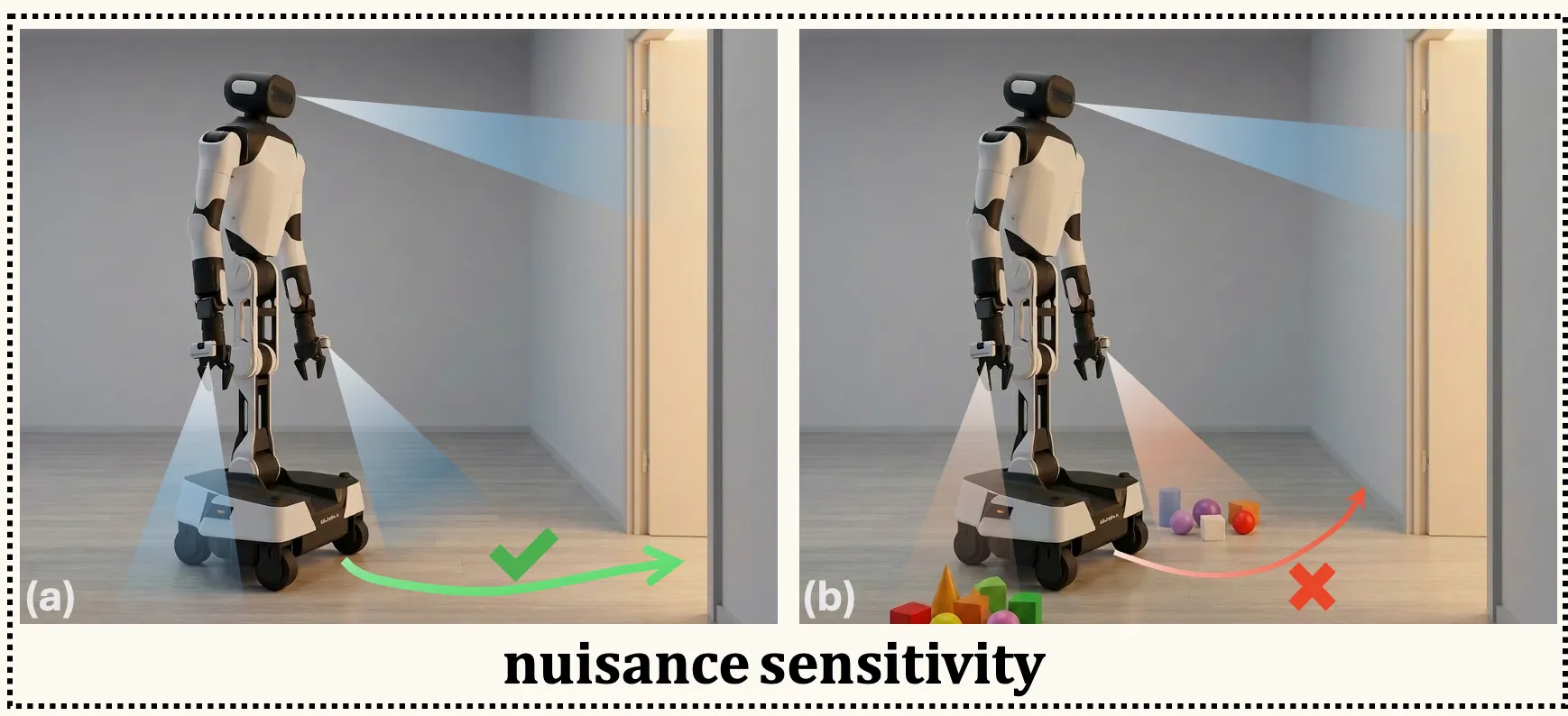
I. Nuisance sensitivity
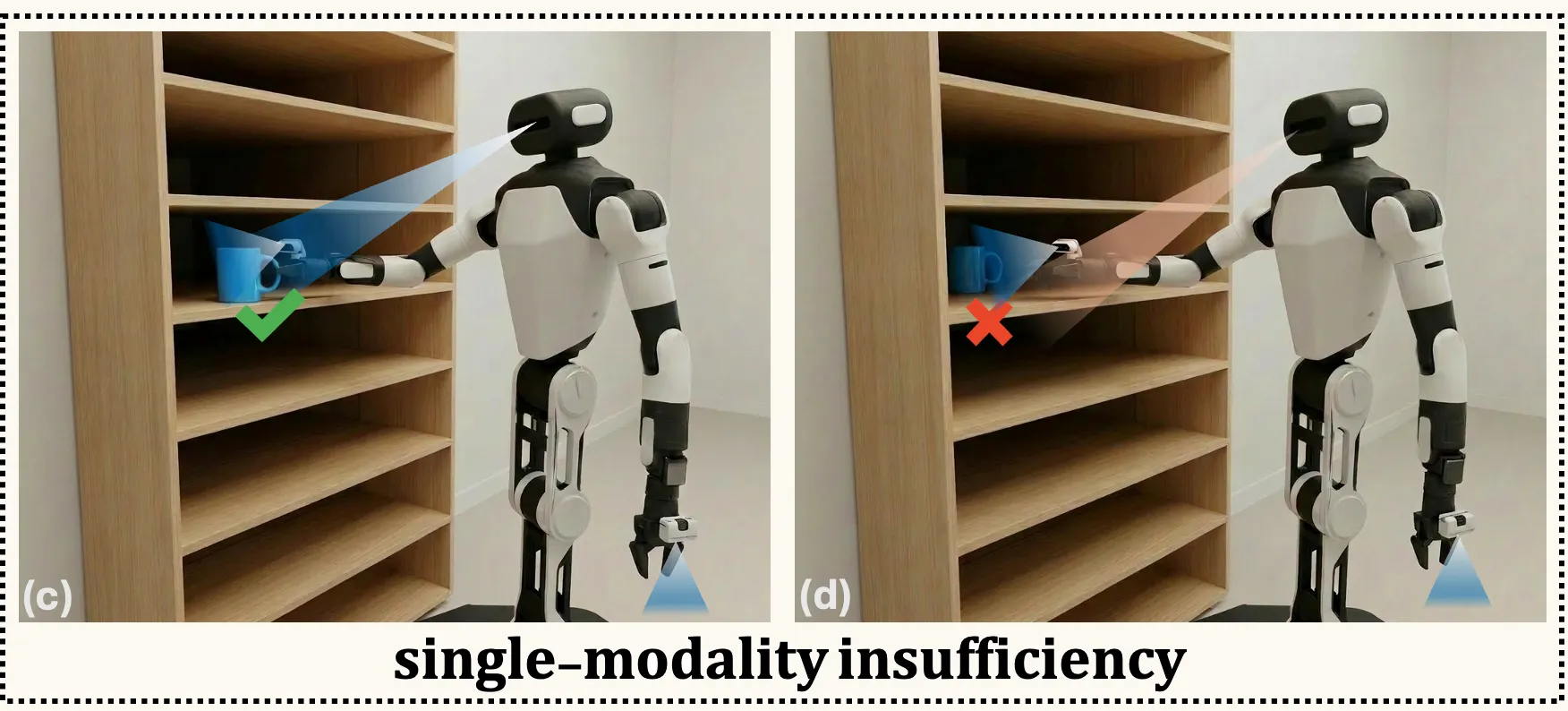
II. Single-modality insufficiency
I. Nuisance sensitivity
During navigation only the head camera carries task-relevant signal; the two downward-facing wrist cameras see floor. Adding physical distractors to the wrist views alone can stall the policy, even though the head view is unchanged. The policy has bound the floor’s specific appearance to “being on the right path.”
The policy over-trusts an irrelevant view.
II. Single-modality insufficiency
Reaching into a shelf, both the head and the right wrist camera see the target. Place the target deeper and the shelf board occludes the head view while the wrist still sees it clearly — yet the policy stops or behaves erratically. It never learned that the wrist alone is sufficient evidence to continue.
The policy fails to fall back on the one intact, useful view.
Evidence-Gated Regularization
EGR separates how task-relevant each sensor is at each frame from how that relevance shapes the policy. The first part is modality-specific; the second is shared across every sensor type. Nothing changes at inference — EGR is a training objective only.
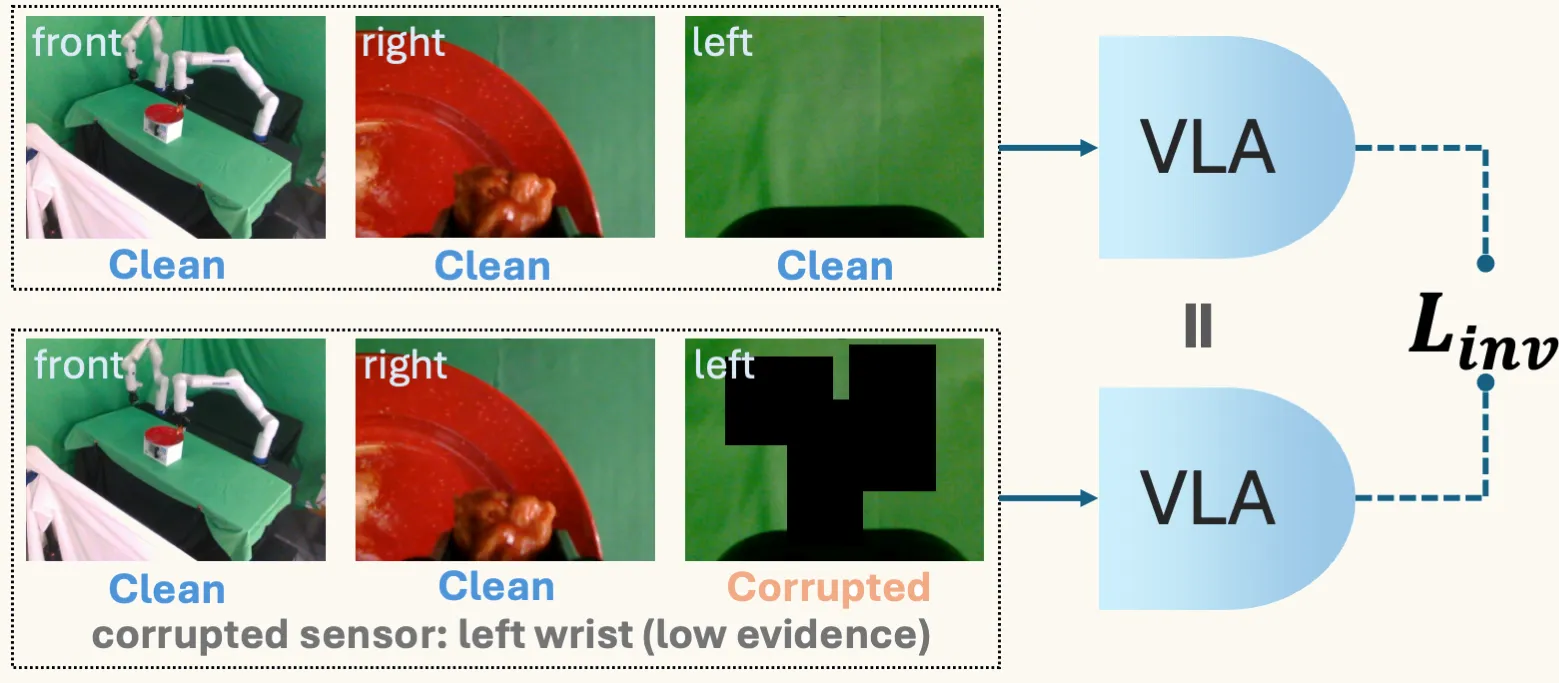
Invariance loss — low-evidence sensor corrupted
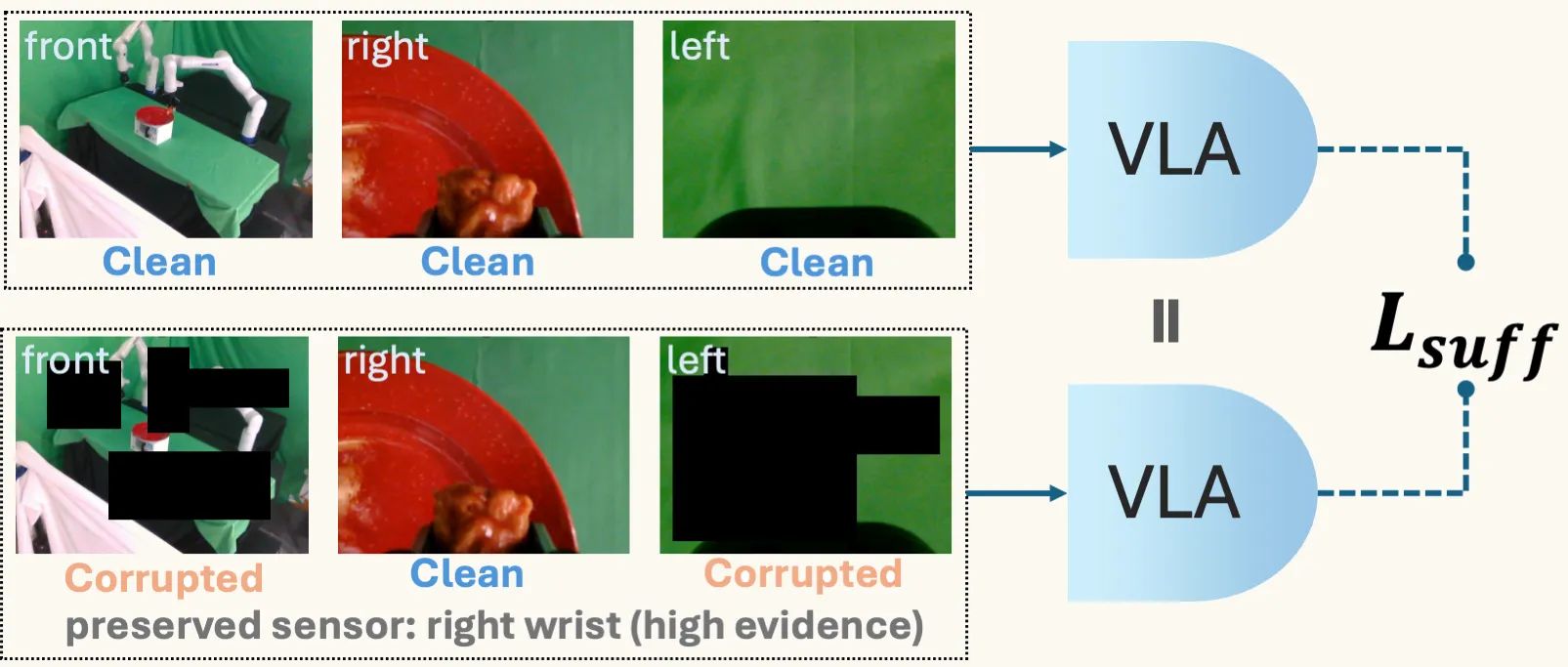
Sufficiency loss — only the high-evidence sensor preserved
The evidence score
For each frame and sensor we assign an evidence score , normalized across modalities so it captures relative importance. It is computed from task structure rather than learned end-to-end from the very demonstrations that caused the problem. It is a heuristic measure of task relevance, not ground truth — its job is to indicate which failure mode a frame is susceptible to, so the right regularizer fires.
- Vision. Evidence is the amount of task-relevant geometry in view. With per-frame instance segmentation and task annotations of focal objects (what is manipulated) and interaction objects (the target or receptacle), the per-camera score is , where the gate admits interaction objects only when the focal object is visible in the same camera — otherwise a large table would inflate cameras that never see the focal object. Cross-camera normalization gives , and a global gate disables both losses on search frames where no camera carries meaningful evidence.
- Tactile. In the sparse-contact regime (grasping, pressing, insertion) contact is the task-relevant event, so is a binary contact indicator. In the rich-contact regime, where contact persists throughout, a task-feature operator scores the current tactile reading against reference signatures from demonstrations.
Two gated objectives
The score selects which failure mode each frame is susceptible to, and therefore which consistency to enforce:
fires on low-evidence sensors: corrupting what does not matter must not change the action. fires on high-evidence sensors: that sensor alone must be enough to act. Both ride on top of the base flow-matching imitation loss,
Because the weights are hinges rather than hard constraints, evidence acts as a soft inductive bias — the policy stays free to find extra structure in any sensor.
Two forward passes, not 2|M|
Written literally, both losses need a corrupted forward pass per sensor, so cost would grow with the number of sensors. An importance-sampled estimator collapses this to two extra passes per step regardless of : instead of summing over every modality, sample one according to the evidence-derived weights and reweight. The appendix proves both estimators unbiased.
Setup, baselines and hyperparameters
- Backbone. EGR is instantiated on π₀.₅, warm-started from its checkpoint. Only LoRA adapters train; base weights stay frozen.
- Baselines. vanilla π₀.₅ is the unmodified backbone. ModDrop adds random modality-token replacement — the modality-dropout strategy of Liu et al. (2017) — to the same backbone. Both use the same architecture and training data as EGR; nothing but the objective differs.
- What “corrupted” means. During training, 2–5 random rectangles covering 30–80% of the frame, filled with uniform noise, applied to all visual inputs including the GelSight RGB. For simulated deployment, 1–3 center-biased black rectangles covering 30–70%, as a controlled stand-in for a large physical occlusion. On the real robots, physical objects placed in view.
- Where segmentation comes from. BEHAVIOR-1K’s own per-frame instance segmentation in simulation; Grounding DINO v2 with manually prompted boxes followed by SAM2, run offline, for real-robot training data. Segmentation is used only at training time — it is never part of the deployed policy.
- Hyperparameters. , , , , .
Benchmark
We build a benchmark on BEHAVIOR-1K targeting modality entanglement directly: 47 curated skill segments — 11 navigation and 36 manipulation — drawn from 11 usable tasks and filtered from 118 candidates by three vision-evidence criteria, with per-segment initial simulator states recovered by demonstration replay.
Two suites
- Suite 1 — inference only. Per-frame action deviation under modality perturbation. No rollouts, so it is cheap to run.
- Suite 2 — rollouts. Task success rate (SR), plus end-effector contact rate (EC) and minimum distance to target (Dist) for manipulation. 20 rollouts per segment.
Four corruption regimes
- Clean — every sensor intact.
- NoUseless — corrupt the useless sensor. Probes nuisance sensitivity.
- UsefulOnly — corrupt all but the one useful sensor. Probes single-modality insufficiency.
- SingleUseful — for setups with exactly one useful sensor; both modes at once.
Results in simulation
Both suites agree. Vanilla π₀.₅ shows the entanglement, and EGR reduces it without giving up clean-input performance — manipulation success under full modalities actually goes up, suggesting evidence gating also helps the policy learn more task-relevant features in the first place.
Suite 2 — task success
| NAV · 11 segments | MAN · 36 segments | ||||
|---|---|---|---|---|---|
| Method | Full | SingleUseful | Full | NoUseless | UsefulOnly |
| vanilla π0.5 | 42.3 | 15.5 | 12.5 EC 52.8 · Dist 0.25 | 9.4 EC 47.2 · Dist 0.26 | 2.8 EC 22.8 · Dist 0.45 |
| ModDrop | 40.0 | 15.5 | 7.5 EC 41.0 · Dist 0.29 | 6.8 EC 38.9 · Dist 0.29 | 2.8 EC 22.4 · Dist 0.47 |
| EGR (ours) | 40.9 | 37.3 | 16.4 EC 50.0 · Dist 0.26 | 16.5 EC 53.9 · Dist 0.25 | 6.1 EC 30.1 · Dist 0.37 |
The headline row: manipulation SR rises 12.5 → 16.4 under full modalities (+31%), 9.4 → 16.5 under NoUseless (+75%), and 2.8 → 6.1 under UsefulOnly (+120%). On navigation, clean performance is essentially preserved (42.3 → 40.9) while SingleUseful more than doubles, 15.5 → 37.3 (+141%).
These absolute rates are low for every method, and deliberately so: these are long-horizon BEHAVIOR-1K skills that no current VLA solves reliably. The comparison to read here is between methods on identical segments, not a claim about deployment reliability.
Suite 1 — action deviation
| NAV | MAN | |||||||
|---|---|---|---|---|---|---|---|---|
| Method | Full | SingleUseful | Δ | Full | NoUseless | Δ | UsefulOnly | Δ |
| vanilla π0.5 | 0.0616 | 0.0809 | +31.4% | 0.0020 | 0.0022 | +12.7% | 0.0052 | +158.5% |
| ModDrop | 0.0853 | 0.1172 | +37.4% | 0.0024 | 0.0026 | +10.9% | 0.0056 | +137.7% |
| EGR (ours) | 0.0780 | 0.0903 | +15.8% | 0.0023 | 0.0024 | +5.1% | 0.0051 | +121.8% |
The vanilla rows are the diagnosis: perturbing sensors the filter labeled useless still moves the action distribution by +31.4% (NAV) and +12.7% (MAN), and dropping to the single useful sensor moves it by +158.5%. ModDrop shows the same pattern — random modality dropout does not remove the entanglement. EGR lowers every ratio.
Read the Δ columns, not the absolute ones. Each method’s deviation is measured against its own Full baseline, so absolute magnitudes are not comparable across rows — EGR’s absolute deviation is in fact higher than vanilla’s, which says nothing about how much a perturbation moves it.
Real-robot validation
We test two platforms with deliberately different embodiments and sensor sets, plus a RealDistractor condition in which a physical out-of-distribution object enters the camera’s view — the only non-synthetic corruption in the evaluation.
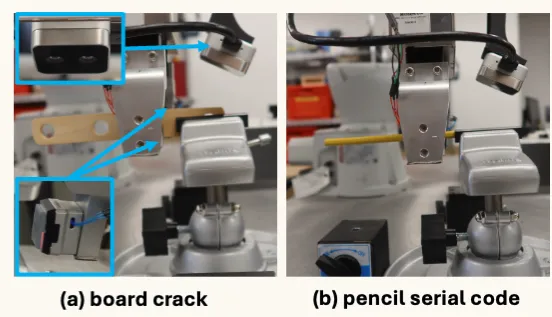
Vision-tactile platform
Bi-manual platform
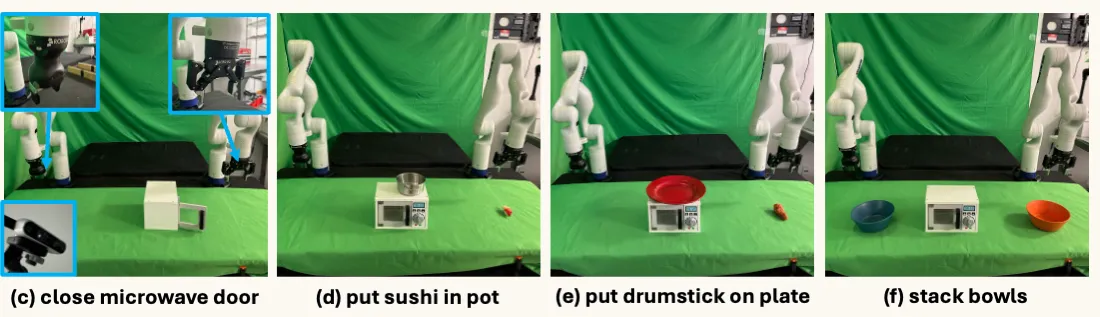
Bi-manual vision platform
Two Kinova arms and three RGB cameras, on four tasks: stack bowls, put drumstick on plate, put sushi in pot, and close microwave door. Four conditions, 10 trials each.
| Condition | vanilla π₀.₅ | EGR (ours) | Relative gain |
|---|---|---|---|
| Clean | 70% | 80% | +14% |
| NoUseless | 52.5% | 90% | +71% |
| UsefulOnly | 25% | 72.5% | +190% |
| RealDistractor | 30% | 85% | +183% |
Bi-manual rollouts
put drumstick on plate · front camera + two wrist cameras 4× speed
The arm picks the drumstick off the table and places it on the plate. The three views feeding the policy are a front third-person camera and one camera on each wrist.
Success criterion. The drumstick ends up on the plate within the episode.
Full sensors — reference
NoUseless
Left wrist camera erased — it carries no task-relevant signal here, so nothing should change.
UsefulOnly
Front camera erased, removing the other informative view and leaving the right wrist as the only useful sensor.
RealDistractor
Unseen physical objects placed in view. No synthetic corruption at all.
Vision-tactile platform
One MELFA ASSISTA arm, one RGB camera, and two GelSight sensors, on two tasks: reading a pencil’s serial code and localizing a board crack. Three conditions, 10 trials each.
| Condition | vanilla π₀.₅ | EGR (ours) | Relative gain |
|---|---|---|---|
| Clean | 90% | 85% | −6% |
| SingleUseful | 40% | 90% | +125% |
| RealDistractor | 55% | 70% | +27% |
Vision-tactile rollouts
pencil serial code · right GelSight view 2× speed
An industrial-inspection task: the arm must find and then hold a specific engraved feature — here the serial code “6014” on a pencil — inside the contact patch of the right GelSight. What you are watching is that GelSight’s output, so it is a contact map rather than a photograph: the target reads as a faint vertical band of raised characters near the centre. Vision is of little use once the pencil is in the gripper, which is what makes this the platform’s single useful sensor.
Success criterion. The target feature stays inside the contact patch for more than 20 s of the 30 s episode. Under SingleUseful below, the baseline loses the feature after 16 s and fails, while EGR holds it for the full episode.
Full sensors — reference
SingleUseful
Vision and the left GelSight erased, leaving only the right GelSight — the sole useful sensor.
RealDistractor
Unseen physical objects in the camera's view, on a platform whose informative sensor is not a camera at all.
The largest relative gain on both platforms comes on RealDistractor, where the distractor is a physical object the policy has never seen — the strongest out-of-distribution signal available to us. The tactile platform confirms that the gains carry to a sensor combination the vision instantiation never touches.
Limitations
- Evidence must be specifiable in advance. EGR needs a task-grounded relevance signal that can be written down from task structure. It does not cover settings where relevance must itself be learned — in-hand object reorientation, for instance.
- “Modality-agnostic” is demonstrated across image-like sensors. The regularizer is sensor-agnostic once evidence exists, but both instantiations here consume images: an RGB camera and a GelSight, whose output is also RGB. Depth, force, and audio — where the erasing corruption operator is not even well defined — remain untested.
- The benchmark covers a slice of BEHAVIOR-1K. 47 segments drawn from 11 usable tasks, filtered by vision-evidence criteria that share a visible-geometry root with EGR’s own vision evidence.
- The evidence score is a hand-designed proxy. Visible pixel area is not the same as information value, and the score is treated as a heuristic throughout.
Takeaway
- Problem. Early fusion causes modality entanglement, which shows up as nuisance sensitivity and single-modality insufficiency.
- Method. EGR uses a task-grounded, per-frame evidence score to enforce invariance on the sensors that do not matter and sufficiency on the ones that do.
- Benchmark. A BEHAVIOR-1K suite of 47 skills that evaluates systematic sensor loss, alongside a cheap inference-only diagnostic.
- Result. A training objective with zero inference cost, delivering large robustness gains in simulation and on two real platforms with different embodiments.
BibTeX
@article{yang2026sensing, title={Sensing Which Modality Matters: Evidence-Gated Regularization for Robust VLA Policies}, author={Yang, Yue and Romeres, Diego and Hori, Chiori and Bertasius, Gedas and Szafir, Daniel and Jain, Siddarth}, journal={arXiv preprint arXiv:2609.03142}, year={2026}}